Arcadia Wood Flooring has spent more than 20 years on wood flooring in Pasadena and across the San Gabriel Valley, and most of what we are asked to do here is keep an old floor rather than replace it. Oak strip and fir that have carried a century of foot traffic usually still have sanding left in them. The job is finding out how much before anyone promises a result.
Before a drum sander comes off the truck, we confirm when the house was built, measure what is left of the boards or the wear layer, and read the subfloor with a moisture meter. Loose boards, nail pops and old repairs get sorted in place first, so the sanding pass works on a sound floor instead of chasing a problem that sits underneath it.
Owners in older neighborhoods often assume a floor restoration will pull them into a review process, and homes exposed to smoke and ash raise a different set of questions. This page covers both, along with raised foundations and the retrofit grant that some Pasadena ZIP codes have appeared on. Every date and program named below comes from a public source we can point to.
Pasadena’s prewar floors: 18,066 homes built before 1940
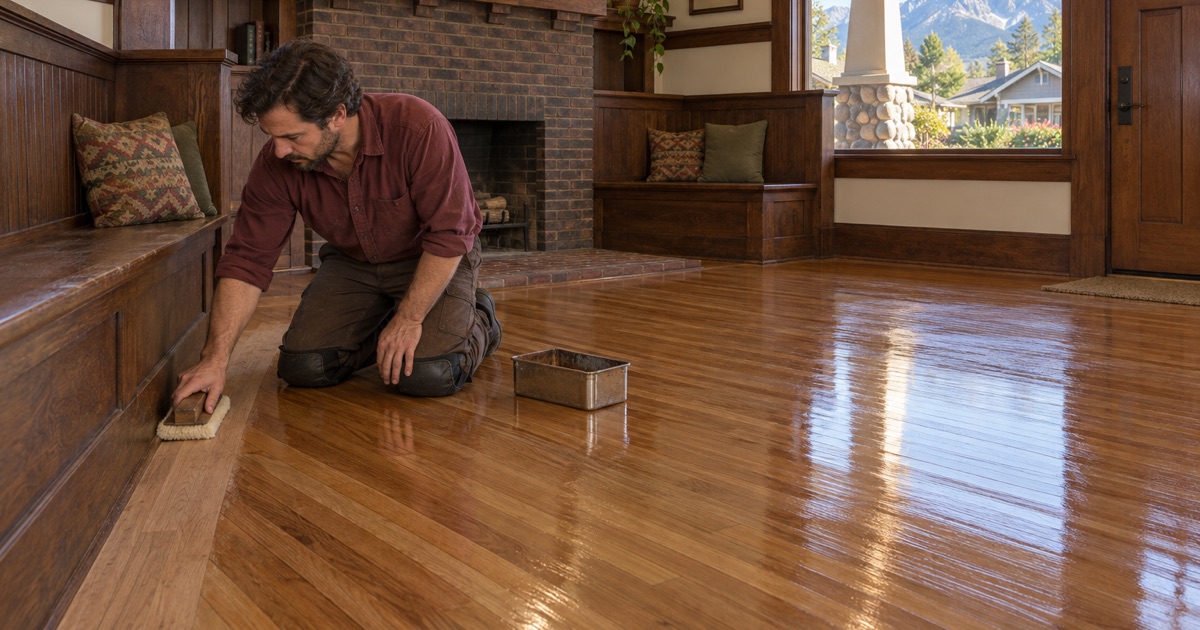
What the build-era numbers say
Census estimates for Pasadena count 63,203 housing units, and 18,066 of them, 28.6 percent, were built in 1939 or earlier. That is more than one home in four built before the Second World War. Homes of that era were typically floored in narrow oak strip or fir over board subfloors, and an original floor that old is worth inspecting before anyone talks about replacing it.
Age alone tells us little about condition. A 1920s strip floor may have been sanded several times, patched around a removed wall heater, or covered with carpet since the 1960s. We pull a floor register or a threshold where we can and look at the tongue before quoting a full sand, because the distance between the top face and the tongue is what decides it.
Fir, oak strip and the layers above them
Fir flooring is softer than oak and shows dents, gray boards near old leaks and black water stains more readily. We match replacement fir by grain and width rather than dropping a new species into the middle of a room. Oak strip takes stain predictably, while fir can blotch, so we test a sample patch on fir before committing to a color.
Old floors also carry old coatings. Shellac, varnish and paint on the boards or along the baseboards can be decades deep, and in a house built before 1978 the federal EPA Renovation, Repair and Painting Rule governs how painted surfaces are disturbed. That is why the build year is confirmed before a sanding date goes on the calendar, and why dust containment is planned from the first room.
Cupping, hollow spots and seasonal gapping
Pasadena falls in the National Weather Service forecast zone named Los Angeles County San Gabriel Valley. Old boards in any house shrink and swell with indoor relative humidity through the year, and seasonal gapping in fir and oak strip is normal to a point. Filling every gap during a dry month tends to crack the filler once the wood takes on moisture again.
Cupping, crowning and hollow spots are a different matter and usually point below the floor. We check the crawl space for moisture, a missing vapor retarder or a plumbing leak before sanding a cupped floor flat, because sanding it early leaves the boards crowned once they dry. Readings are written down and dated, so the owner can see whether the floor is settling or still moving.
Looking for wood-flooring closer to Alhambra? See Alhambra Wood-Flooring.
Landmark districts and the owner’s call on original floors
Design review covers exteriors, not interiors
The City of Pasadena states that in its landmark districts, interior alterations are exempt from Certificate of Appropriateness review, along with paint colors, landscaping and routine maintenance. A Certificate of Appropriateness is required for demolitions, exterior alterations and new construction. Refinishing, repairing or restoring a floor inside the house is an interior alteration, so the design decision about how to treat it rests with the owner.
That exemption is from design review only. It says nothing about building permits, which remain a question for the Building and Safety Division of Pasadena’s Planning and Community Development Department when floor work reaches framing or structure. The city also notes that the State Historical Building Code applies to both the interior and exterior of a building. We raise both points before a structural repair is scoped.
Bungalow Heaven and prewar Craftsman floors
Bungalow Heaven, roughly 800 small Craftsman homes built between 1900 and 1930, became Pasadena’s first landmark district in 1989. Floors in houses of that age were commonly oak strip in the front rooms and fir in kitchens and service rooms. Restoring them in place usually means resetting loose boards, setting nail pops, quieting squeaks from the crawl space and sanding only as deep as the finish requires.
Because the interior exemption leaves the choice with the owner, we lay out the options plainly: a full sand to bare wood, a screen and recoat over a sound finish, or spot repairs using boards salvaged from closets or matched by grain. Where original boards are too thin to sand again, we say so before work starts rather than discovering it halfway across a living room.
Mills Act properties
Pasadena’s Mills Act Historic Property Contract Program dates to October 2002. Eligible properties include designated landmarks, Greene and Greene buildings, National Register properties and contributing properties in landmark or National Register districts. Greene and Greene’s Gamble House is itself a California Historical Landmark.
For an owner with a Mills Act contract, we write up the floor work in a form that is easy to file: species and width of the existing boards, what was repaired or replaced and with what, the abrasive grit sequence, and the finish product applied. We do not advise on contract terms. The record simply makes it clear the original floor was kept rather than covered or torn out.
After the Eaton Fire: ash, soot and interior floors
Cleaning before refinishing
The Eaton Fire began on January 7, 2025, and The Center Square, in a report carried by Yahoo News, stated that 185 structures were destroyed within Pasadena city limits. For properties that are still standing, the city’s recovery page publishes Cleaning Guidance for Ash, Soot, and Smoke After a Wildfire for residential properties. We ask owners to start there before any floor work is scheduled.
Ash residue is gritty, and dragging it across a finished floor with a dry broom or a rolling chair scratches the finish the way sandpaper would. Once the surfaces have been cleaned, we look at whether soot has worked into gaps between boards, under shoe molding and quarter round, or into a worn-through finish where bare wood can hold odor. That inspection decides between a cleaning and recoat and a full sand.
Smoke and ash documentation for an adjuster
Insurance claims for smoke damage are easier to follow when the evidence is organized. We photograph each room before anything is moved, record moisture meter readings where firefighting water or rain came in through damaged openings, and note soot lines along baseboards and thresholds. Each photo is labeled by room so an adjuster can match it to the written scope without guessing.
We stay out of the claim itself. Our part is describing what the floor needs, whether that is odor sealing under a new finish, board replacement where heat or water cupped the wood, or a sanding pass to clear residue from open grain. If a house needs structural or rebuild work first, the city’s rebuild permit status map and Planner-of-the-Day consultations are the place to begin.
Finishes that meet South Coast rules
Floor finishes applied in the South Coast air district fall under SCAQMD Rule 1113, which limits wood coatings to 275 grams per liter. We choose sealers and topcoats from products legal to apply here rather than from a national catalog. Waterborne polyurethane is often the choice in a house that has already dealt with smoke odor, since it carries far less solvent smell than an oil-modified finish.
Cure time matters as much as the product. A waterborne coat can be walked on in socks well before it is ready for rugs and furniture, and pushing furniture back early leaves marks in a finish that looked dry. We hand over a written room-by-room schedule showing when people, then furniture, then rugs can return, which matters most for a household already living around recovery work.
Raised floors and Earthquake Brace + Bolt in Pasadena ZIP codes
Bouncy floors, soft spots and the crawl space
A house on a raised foundation has a crawl space, floor joists and often a board subfloor under the finished wood. A bouncy floor, a soft spot near a bathroom or a sloping floor across a hallway is often a joist or subfloor problem rather than a flooring one. We look underneath before quoting, since no sanding pass fixes a floor that moves underfoot.
When the fix is a sister joist or new blocking, the structural work comes first and the floor waits for it, with the permit question settled with Building and Safety. Termite frass and kick-out holes near the floor are noted and photographed too, because a new finish over active drywood termite damage hides it without stopping it. We refer that inspection out rather than guessing at it.
The 2025 Brace + Bolt ZIP list
Pasadena ZIP codes 91101, 91103, 91104, 91105, 91106 and 91107 appeared on the 2025 Earthquake Brace + Bolt list for Southern California. The program funds up to $3,000 toward bolting and bracing wood-framed, pre-1980 homes on a raised foundation. Eligibility can change from year to year, so owners should check the program’s current ZIP codes before planning around a grant.
Timing the two jobs matters. Foundation bolting and cripple wall bracing happen in the crawl space, and the vibration and occasional access from above can disturb a freshly finished floor. When an owner is planning both, we suggest letting the retrofit finish first, then sanding and coating once nobody needs to open a floor hatch again. Drilling and dust from below can also settle into a finish that has not fully cured.
Quoting stairs and thresholds separately
Stairs wear differently from a room, with most of the damage on the front edge of each step. We price each stair tread, riser and stair nosing on its own line instead of folding them into a square-foot rate, so an owner can see exactly what the stairs cost. A badly worn nosing may call for a retrofit tread, while a sound tread is sanded by hand.
Thresholds get the same attention. Threshold water damage at exterior doors, gray boards at an old sliding door and sun fading across a south-facing room are each priced as their own repair. On an old strip floor, a weave-in repair that staggers new boards into the field hides far better than a straight patch cut across the room.
- 20+ Years on Wood Floors
- Room-by-Room Schedules
- Stairs Priced by the Step









