Arcadia Wood Flooring has spent more than 20 years on wood-flooring in San Gabriel, and most of what we are called to here is an older floor rather than a new one. Oak strip that has been under carpet for decades, parquet with a few tiles rocking loose, a finish worn through in the hallway: these are the jobs that fill our schedule in this city.
We start every job the same way. Before a sander is booked, we confirm the year the house or townhome was built, because finish and paint layers from before 1978 fall under the federal EPA Renovation Repair and Painting Rule, and that changes how dust is contained and cleaned. We would rather know it on the first visit than discover it halfway through a room.
From there the work is planned in writing. You get a room-by-room schedule that says when rugs, furniture and the people living there can return, whether the household is an owner, a tenant or three generations under one roof. Stairs are priced by tread, riser and nosing, not buried in a square-foot rate, so the quote reads the way the job will actually be done.
Wood Floors in San Gabriel’s 1940s Houses
The 1940s are the largest single build decade in San Gabriel. The American Community Survey 2024 five-year estimates count 2,872 of the city’s 13,818 housing units built between 1940 and 1949, or 20.8 percent, and another 2,444 units, 17.7 percent, built in 1939 or earlier. Put together, 38.5 percent of the housing stock predates 1950. That is a lot of wartime and early-postwar flooring still in service.
Reading a floor from the 1940s
Floors from that era were typically site-finished solid hardwood, most often red oak or white oak strip nailed through the tongue and groove, sometimes fir in back rooms or under later coverings. They were built to be sanded, and many have been sanded before. Our first job is finding out how much wood is left above the tongue, which we check at a floor register or an exposed edge rather than guessing from the surface.
An eighty-year-old strip floor tends to show its age in predictable places. Gray boards and black water stains collect near old sinks and exterior doors, squeaks and nail pops follow the traffic path, and a sloping or bouncy section can point to a tired floor joist rather than the boards. We note each one before quoting, because a refinish over a structural soft spot does not last.
Repairing boards before the sander runs
Where a board is split, stained through or eaten by drywood termites, we cut it out and weave in replacement strip of matching species and width, staggering the joints so the patch disappears once the floor is sanded. Termite frass or kick-out holes in the wood get flagged to you before we go further, since that is a pest question first and a flooring question second.
Parquet turns up in some older San Gabriel homes as well. When tiles are lifting or sound hollow, we reset the loose ones and match any missing pieces before sanding starts. The black mastic underneath is treated as a question to answer before any tile comes up, never scraped on a guess. If the wood still has life in it, restoring it in place keeps more of the house than tearing it out.
Looking for wood-flooring closer to Baldwin Park? See Wood-Flooring in Baldwin Park.
The Mission District and a Preservation Record Dating to 1965
San Gabriel grew up around Mission San Gabriel Arcángel, founded by Junípero Serra in 1771, and the city still carries the motto City With A Mission. It incorporated on April 24, 1913. The city has completed historic resource surveys for four portions of town, ranging from the Mission District to commercial architecture along Valley Boulevard.
Second in the county to adopt an ordinance
San Gabriel adopted a historic preservation ordinance in 1965, the second city in Los Angeles County to do so after Los Angeles itself. It passed an updated Historic Preservation and Cultural Resource Ordinance on August 15, 2017, which set out designation procedures, created the Historic Preservation and Cultural Resource Commission and allowed local historic districts. The update earned the city a 2018 Los Angeles Conservancy award.
What that record means for a flooring job is simpler than it sounds. A 1940s oak floor in a city with this long a habit of documenting what it keeps is worth repairing board by board, and we plan the work that way. We do not treat the ordinance as a ruling on interior work, and questions about a property’s designation belong with city preservation staff.
What the Mills Act does and does not cover
It is fair to wonder whether the city’s Mills Act Property Tax Program reaches inside the house. Under the guidelines dated December 3, 2021, a property must be a designated City Landmark or historic district contributor, or be listed on the National or California Register, and the tax savings are meant for exterior rehabilitation and maintenance. Applications are due June 30. So we price interior floor work on its own merits, with no tax program folded into the numbers.
Who answers the building questions
Structural questions go to a different office. If a sagging section turns out to need joist work, the City of San Gabriel Community Development Department’s Building and Safety Division, at 425 S. Mission Drive, is the authority on what that repair requires. Walk-ins are taken from 8 a.m. to 11:30 a.m., and we would rather you hear the answer from that counter than from a contractor’s guess.
Townhomes in San Gabriel, Many of Them Rented
Not every floor here sits in a detached house. One-unit attached structures, the townhome and rowhouse form, account for 1,672 units, or 12.1 percent of the city’s housing. Within that group, renters outnumber owners by a wide margin: 999 renter households against 411 owner households, according to ACS tables B25024 and B25032. Citywide, tenure splits almost evenly, with 50.4 percent of occupied units owner-occupied.
When the owner and the occupant are different people
A rented townhome changes who needs to hear what. The owner approves the scope and the budget, while the tenant needs to know which rooms are out of use, for how long, and when furniture can go back. Our written schedule is built for both readers, so a landlord can forward it without rewriting a word. Between tenancies, when a unit is empty, is usually the easiest window for a full sand.
Turnover also brings the security deposit question. We can describe what we find, such as pet urine stains that have gone black into the wood, deep gouges or sun fading near a window, in plain terms with photos. Whether a given mark counts as normal wear and tear is a decision for the owner and the tenant, not for us, and we keep our notes factual so they serve either side.
Floors that share walls with neighbors
Attached units put another household a wall away, which shapes how we run a job. We use dust containment and dustless sanding equipment wherever the floor allows it, keep the loudest drum sander and edger work to hours agreed on in advance, and seal off shared entries so a neighbor’s hallway stays clean. A short note to the neighbors before the first loud day tends to save everyone a knock on the door.
A townhome floor is also rarely a blank slate. Glue-down engineered hardwood, a floating floor over underlayment, or an older nail-down strip floor each call for a different approach, and on engineered flooring we measure the wear layer before promising a full sand. A thin veneer can often take a screen and recoat, but not a sanding.
Choosing a Finish for an Older San Gabriel Floor
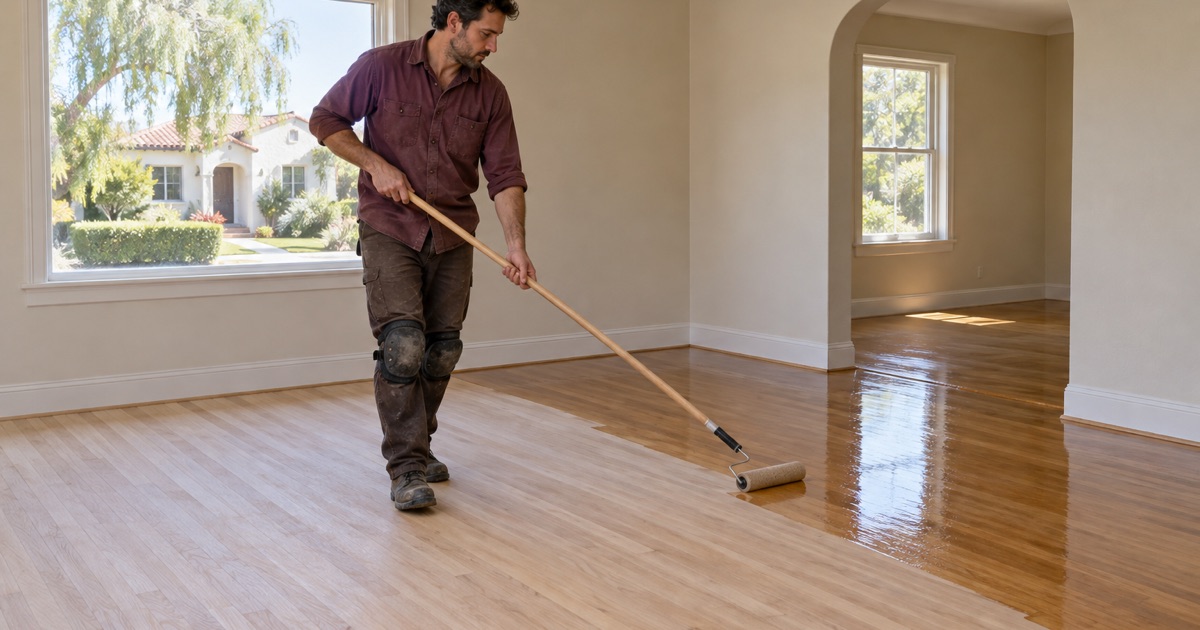
Once the wood is sound, the finish decision is where a 1940s floor either keeps its character or loses it. We lay stain samples on the floor itself before anyone chooses, rather than working from a brochure. Old red oak and white oak take the same stain very differently, and so do boards woven in during repair.
Finishes that meet South Coast AQMD limits
San Gabriel sits in the South Coast Air Quality Management District, where SCAQMD Rule 1113 sets the wood coatings VOC limit at 275 grams per liter. We choose from products that are legal to apply here rather than from a national catalog, and we check the label on each one against that limit before it comes into the house.
The choice between finishes is mostly about look and upkeep. A waterborne polyurethane stays clearer and keeps oak from yellowing further, while a hardwax oil gives a lower sheen and is easier to spot-repair but asks for more regular maintenance. We explain the cure time and recoat window for whichever you pick, since that sets when the rooms reopen.
Seasonal movement in an old floor
Strip floors that have lived through eighty summers and winters open and close with the seasons. Before we fill gaps or blame a board for cupping, we take moisture meter readings and write them down, then compare them with the wood’s likely equilibrium moisture content for the time of year. A gap that closes by late summer may not need filling, and filler forced into it can crack out or crush the board edges.
Water losses get the same treatment. When a floor by a sliding door or a kitchen sink has cupped or turned gray, we document it with photos and dated moisture readings an insurance adjuster can use, and the same goes for smoke or ash residue after a fire. Drying and documentation come first, and sanding waits until the readings settle.
Screen and recoat versus a full sand
Not every older floor needs to go back to bare wood. If the finish is dull or lightly scratched but not worn through, a screen and recoat adds a fresh coat without removing wood, which matters on a strip floor that has already been sanded more than once. When the finish is peeling, bare wood shows through, or old repairs need blending, a full sand with a proper abrasive grit sequence is the honest recommendation.
- 20+ Years on Wood Floors
- Room-by-Room Schedules
- Stairs Priced by the Step









