Arcadia Wood Flooring has handled wood flooring in San Marino and across the surrounding valley for more than 20 years, and most of that work here is restoration rather than replacement. The floors we see in this city are usually the ones the house was built with, and our job is to bring them back without losing what makes them original. That means sanding only as deep as the wood allows, matching boards where pieces are missing, and finishing with products chosen for this air district.
Before a sander touches anything, we confirm when the house was built. Federal lead-safe renovation rules cover housing built before 1978, and older finish and paint layers can sit under the surface we are about to open, so the build year shapes how we contain dust and plan the work. We write that answer down with the quote instead of assuming it.
We also take the finish question seriously. Every coating we apply is legal in the South Coast air district, where the limit for wood coatings is 275 grams per liter, so the sheen and color options we show you are ones we can actually put down. Once the work is planned, you get a written schedule, room by room, showing when furniture, rugs and family can return.
Restoring Floors in Houses Built Before 1950
How Old the Housing Here Really Is
San Marino’s housing stock is old by any measure. Census figures from the 2024 American Community Survey five-year estimates count 4,439 housing units in the city, and 1,811 of them, or 40.8 percent, were built in 1939 or earlier. Add the 1940s and the share built before 1950 reaches 69.0 percent. Just 3.2 percent of units date from 2000 or later, so a new house is the exception rather than the rule.
For flooring, that age means the floor in front of us has often been refinished before. Each past sanding took some wood off the top of the board, so the first thing we check on a prewar floor is how much remains above the tongue and groove. A floor with enough left gets a full sand; a floor that is close to the tongue gets a lighter approach or targeted board replacement.
Lead and Old Finish Layers
The age figures carry a practical consequence. In San Marino, 92.9 percent of housing units predate 1980, and the EPA Renovation, Repair and Painting Rule governs work in pre-1978 housing. Old varnish, shellac and painted baseboards or shoe molding can all be part of what a sanding job disturbs. We plan dust containment around that before quoting a timeline, and we keep sanding dust inside the work area rather than letting it travel through the house.
Containment matters more in a large house than a small one. A long prewar floor often runs through a living room, dining room and hall without a threshold break, so we seal off the rooms being sanded and schedule the rest of the house around them. Dustless sanding equipment helps, but it does not replace a sealed work area. Owners who stay in the house during the job know which rooms are open each day.
Owner-Held Houses and Long Horizons
Most San Marino households own their home: 3,237 of 3,910 occupied units, or 82.8 percent, are owner-occupied. An owner planning to stay tends to ask a different question than a landlord turning over a unit, and that question is usually how to keep the original floor for another few decades. We answer it by removing as little wood as the damage requires, so the next refinish still has something to work with.
Looking for wood-flooring closer to San Gabriel? See San Gabriel Wood-Flooring.
Period Revival Houses and Their Original Floors
The Styles Behind the Floors
The City of San Marino’s Historic Resources Survey Report, finalized in October 2020, found that Period Revival styles dominate the city’s houses. That covers Spanish Colonial and Mediterranean houses, Tudor and French designs and American Colonial homes, with Ranch and Minimal Traditional houses in the neighborhoods built before and after World War II. The report also notes that residential building revived in 1935.
Houses of this era commonly carry more than one kind of wood floor. Oak strip flooring in main rooms, fir flooring in secondary spaces and the occasional parquet or herringbone pattern in an entry or library are all typical of the period. Knowing what the original builder likely used helps us source matching species, grain and board widths when a repair is needed. Red oak and white oak take stain differently, so we identify the species before promising a color match.
Parquet and Pattern Floors
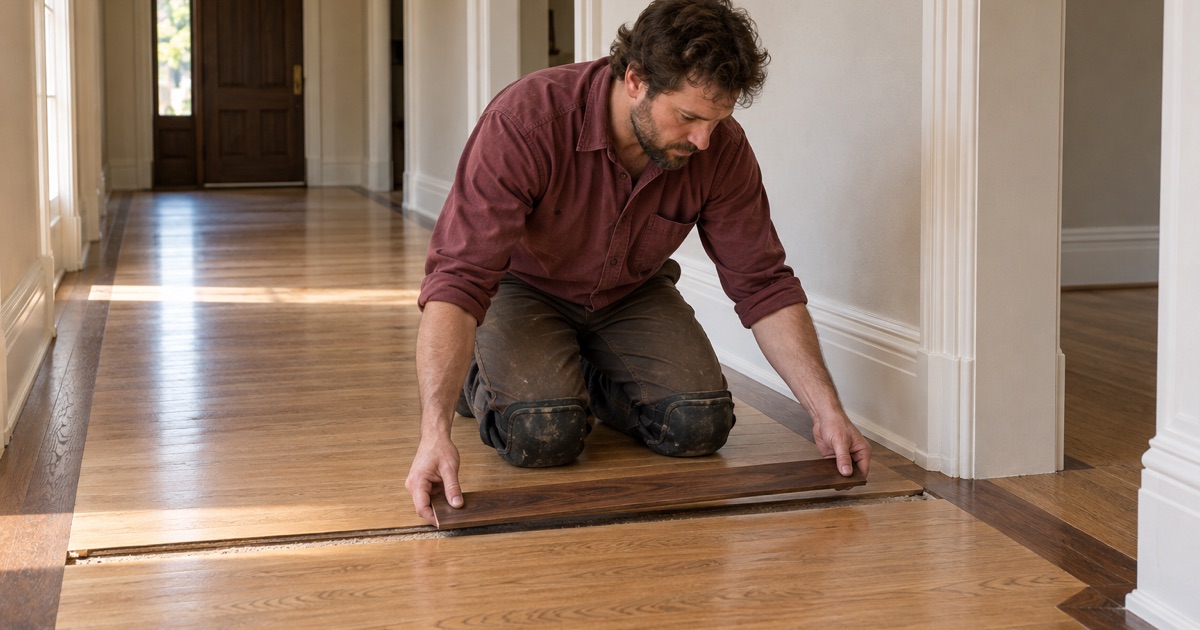
Pattern floors in older houses bring their own problems. Loose parquet, lifting parquet and hollow spots under block parquet usually trace back to the adhesive or the subfloor rather than the wood itself. We reset loose tiles and match missing pieces before any sanding starts, so the drum sander never runs over a tile that is about to move.
The glue underneath deserves the same care. Old black mastic and cutback adhesive can sit under a parquet floor, and we treat what is there as a question to answer before tiles come up, never something to scrape off on a guess. The answer decides whether a lifting section is reset in place or taken up with more caution. Either way, the old pattern stays, because a restored herringbone or chevron floor is hard to replace with anything of equal character.
Stairs, Landings and Trim
Two-story Period Revival houses often have a stair that takes as much traffic as any hallway. We quote stairs by the tread, riser and stair nosing rather than folding them into a square-foot price, because every step is sanded and finished by hand. Landing treads and worn nosings are usually where a stair shows its age first.
Trim needs attention too. Original baseboards in these houses are often part of the character worth keeping, so we pull and reset shoe molding and quarter round where needed instead of cutting into the base. Where old paint coats the base or shoe, the lead rule for pre-1978 housing shapes how that trim is handled.
Oak Knoll and the Estate Lots
Large Lots, Large Floor Plans
San Marino covers about 3.76 square miles, and its seven residential zones run from a smallest lot of about 4,500 square feet to many where lots average over 30,000 square feet. Most homes were built between 1920 and 1950. On the larger lots, that often means large houses with long, continuous runs of original flooring.
Big floor plans change the logistics of a refinish. A full sand and finish across a whole ground floor involves more coats, more cure time and more rooms off limits than owners often expect. Every coat has a recoat window that has to be respected, so our schedule breaks the job into zones and lets the household use part of the house while the rest cures.
Oak Knoll and the Northwest Hills
The survey report identifies Oak Knoll, in the city’s hilly northwest, as the area with the largest lots and curvilinear streets. The broader street grid follows the Pacific Electric routes Henry E. Huntington built from 1903 to 1906, after he bought the Shorb rancho in 1903. The city incorporated on April 25, 1913.
Houses on hillside estate lots bring access questions into a flooring job. Long driveways and stepped entries affect where we stage equipment and how we bring a drum sander and edger inside without marking floors that are not part of the job. We walk the route before day one, protect it, and keep heavy equipment off any floor that has just been coated.
Seasonal Movement in a Valley Forecast Zone
San Marino sits in the National Weather Service forecast zone for the Los Angeles County San Gabriel Valley, CAZ548. That zone’s forecast is the one we check when planning finish work, since relative humidity affects both cure time and how boards move. Seasonal gapping between old strip boards is normal wood behavior, not automatically a defect.
When an owner reports cupping, crowning or gaps that never close, we take moisture meter readings across the floor and record them before blaming the boards. Those readings also matter after a water loss at a sliding door or threshold, where photos and documented moisture levels give an adjuster something concrete to work from. The same record helps later, when the owner wants to know whether a repair held.
Designated Landmarks and Repair Before Replacement
Designated Landmarks and the Certificate of Appropriateness
San Marino adopted its Historic Preservation Ordinance, Municipal Code Chapter 23.18, in 2018, and the Planning Commission serves as the preservation commission. The city requires a Certificate of Appropriateness before any alteration, restoration or rehabilitation of a designated historic landmark. The survey report lists nine formally designated landmarks, among them the Edwin Hubble House from 1925 and El Molino Viejo.
Whether that requirement reaches interior floors is not something we assume in either direction. If your house is a designated landmark, we ask you to confirm with the City of San Marino Community Development Department at 2200 Huntington Drive before work is scheduled. The city’s separate Design Review Committee looks at alterations that change a house’s appearance from a public street or alley, along with new or replacement residences.
A City of Single-Family Houses
Of San Marino’s 4,439 housing units, 4,377 are detached houses, or 98.6 percent, and the census reports none in buildings of five or more units. The survey report adds that no areas of the city are zoned for multi-family residential use. For flooring, that means nearly every job here is a whole-house conversation with the people who live there.
When to Repair a Floor Instead of Replacing It
Replacement is rarely our first recommendation on an original prewar floor. Pet urine stains, black water stains and gray boards can often be handled with board replacement or a weave-in repair using matched wood, which keeps the layout and age of the floor intact. Chatter marks, edger swirl and drum marks left by past refinishes can usually be sanded out if enough wood remains.
Some floors need less than a full sand. A worn or cloudy finish with no damage to the wood may only need a screen and recoat, and an engineered floor added in a later remodel gets its wear layer measured before we promise any sanding at all. When a floor is truly past saving, as with a sand-through or widespread termite damage, we say so plainly and explain what replacement would involve.
- 20+ Years on Wood Floors
- Room-by-Room Schedules
- Stairs Priced by the Step









