Arcadia Wood Flooring handles subfloor repair in Arcadia, CA, serving surrounding cities including Mayflower Village, North El Monte, East Pasadena, South Monrovia Island and Temple City. In 20+ years of working on wood floors, we have learned that many problems people see on the surface start below it. A soft spot by a toilet, a room that slopes, or boards that will not stop squeaking usually trace back to plywood, board subfloor or joists underneath.
We start every subfloor job by finding the cause. That means checking from the crawl space on raised foundations, taking moisture readings, and looking for leaks, rot, damaged joists and loose fasteners. On slabs, it means checking flatness, cracks and moisture before any wood goes back down.
Once the structure is sound, we repair or replace the damaged subfloor and restore the finished floor above it. The goal is a floor that stays flat, feels solid and lets the wood on top last as long as it should.
Signs Of Subfloor Damage
Soft Spots Near Bathrooms And Kitchens
A soft spot that gives underfoot near a toilet, tub, shower or dishwasher often means water has damaged the subfloor below. The wood on top may look fine for a while before cupping, staining or loose boards appear.
We probe the area, take moisture readings, and inspect from below where there is access. Damaged sections are cut back to solid material, and the leak source is identified so the repair is not ruined by the same water.
In older houses with board subfloor, rot sometimes spreads along a single plank farther than the visible soft spot suggests. We follow the damage until the wood is sound rather than patching only the part that flexes.
Sagging, Sloping And Bouncy Floors
A sagging floor shows a dip between walls, while a sloping floor tilts noticeably in one direction. A bouncy floor flexes or makes objects rattle as someone walks across it.
These symptoms can come from a cracked or undersized floor joist, missing support posts, weakened subfloor between joists, or settling in the foundation. We check the structure before recommending any fix, since the right repair depends entirely on the cause.
Some slopes are old and stable, while others are still moving. Measuring the floor and looking for fresh cracks in plaster, sticking doors and new gaps helps tell the two apart.
Persistent Squeaks And Nail Pops
Squeaks often happen when a subfloor is not tight to the joists or when fasteners have loosened as wood dried and moved. Nail pops show up as small bumps or raised nail heads through the finished floor.
From a crawl space, we can secure the subfloor to the joists with screws or shims without disturbing the finished surface. Where the space below is not accessible, we work from above and conceal fasteners in the grain.
Water Damage Under The Floor
Plumbing Leaks And Slow Drips
Slow leaks from supply lines, drains, wax rings and appliance hoses can soak the subfloor for months before anyone notices. By the time boards cup or a stain appears, the plywood or board subfloor may already be delaminated or rotted.
We document damage with photos and moisture readings, then remove wet and weakened material. The area is dried and checked again before new subfloor goes in, so trapped moisture does not start a new problem.
Threshold Water By Sliding Doors
Water that comes in under a sliding glass door can damage the finished boards and the subfloor directly beneath the threshold. Repeated wetting often weakens the edge of the subfloor, leaving a dip or soft area at the doorway.
We replace damaged subfloor sections, add support where the edge has weakened, and weave new flooring into the existing floor. The door sill or flashing issue is noted so it can be corrected before the next heavy rain.
Crawl Space Moisture
A crawl space with standing water, missing vapor barrier over the soil or poor ventilation keeps the subfloor damp. Over time, that moisture can cause cupping in the finished floor, mold growth and rot in joists and subfloor.
We look at the crawl space conditions before replacing material. Where moisture control work is needed, we explain what we found so it can be corrected alongside or before the subfloor repair.
Structural Repairs Below The Floor
Sistering Damaged Joists
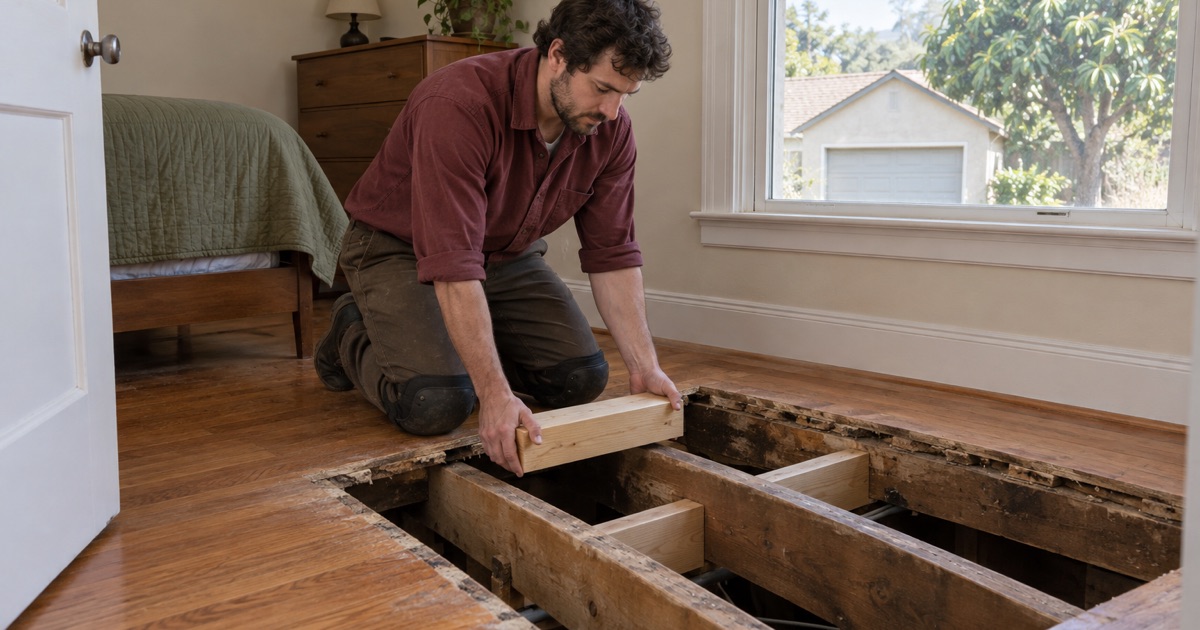
A sister joist is new lumber fastened alongside a cracked, sagging or notched joist to restore its strength. It is often a practical fix when the original joist can stay in place but no longer carries load well on its own.
We size and fasten sister joists to match the span and load, and we make sure the subfloor above is flat before new flooring goes down. Where damage suggests a larger structural issue, we recommend an engineer’s review before proceeding.
Replacing Plywood And Board Subfloor
Rotted or delaminated plywood subfloor is cut back to solid wood and replaced with new panels of matching thickness. Edges are supported on joists or blocking so the repair does not create a soft seam.
Older houses with board subfloor are repaired to the same height, sometimes with plywood patches shimmed to match. A flush repair is what lets the finished wood floor sit flat across the transition.
Cripple Walls And Foundation Bolting
In older raised-foundation houses, cripple walls and foundation bolting are part of how the house handles earthquakes. While we are in the crawl space, we sometimes notice missing bolts or unbraced cripple walls.
Seismic retrofits are specialized work that we do not perform. We note what we saw and suggest a retrofit contractor, and some owners look into California’s Earthquake Brace + Bolt program for help with that cost.
Subfloor Work Before New Flooring
Preparing For Hardwood Installation
Before installing new hardwood, the subfloor has to be flat, dry and secure. We fasten loose panels, replace damaged sections, and correct high and low spots so boards lay tight.
Moisture readings are compared between subfloor and new flooring. When the two are too far apart, installation waits, because a floor laid over the wrong moisture conditions is likely to gap or cup.
Preparing Slabs For Glue-Down Or Floating Floors
Concrete slabs are checked for cracks, flatness and moisture before engineered hardwood or parquet is glued down or floated. We use the ASTM F2170 in-situ relative humidity test when moisture levels need to be measured accurately.
High spots are ground, low spots are filled, and a vapor retarder or moisture-control system is used when readings call for it. That prep work decides whether the new floor stays bonded and flat.
Refinishing After Subfloor Repairs
When the subfloor repair only affects part of a room, replacement boards are woven into the existing floor. The area can then be sanded and finished to blend with the surrounding wood.
We use finishes that meet the South Coast air district limit of 275 grams per liter for wood coatings. A written schedule shows when the repaired area can be walked on and when furniture can return.
- 20+ Years on Wood Floors
- Room-by-Room Schedules
- Stairs Priced by the Step