Arcadia Wood Flooring installs, repairs and refinishes wide plank flooring in Arcadia, CA, and in 20+ years on wood floors we have seen that wide boards are both the most striking choice and the least forgiving. The width that lets grain carry across a large room also magnifies every change in moisture, so a wide plank floor has to be planned around how wood moves rather than how it looks in a showroom.
In larger, newer houses, wide plank floors often draw calls about seasonal gaps. Before any board gets blamed, we take moisture readings and write them down. That record helps separate normal seasonal gapping from cupping, installation problems or moisture coming from below.
Whether you are choosing a new wide plank floor or trying to understand the one you have, we explain construction, species, installation method and finish in practical terms, with a written scope and room-by-room schedule for the work.
Choosing Wide Plank Hardwood
Engineered Wide Plank
Engineered wide plank uses a real wood wear layer over a plywood or composite core. The cross-layered core resists swelling and shrinking better than a solid board of the same width, which makes engineered construction a strong fit for wide boards, slab-on-grade houses and open floor plans.
Wear layer thickness still matters. A thick wear layer can be sanded in the future, while a thin one is limited to screen and recoat, so we check that before recommending a product.
Solid Wide Plank
Solid wide plank is one piece of wood throughout and can be sanded many times over its life. It moves more across its width than engineered flooring, so it needs a stable wood subfloor, careful acclimation and consistent indoor humidity.
Solid wide plank works best over raised foundations where moisture can be measured and controlled. Installing it directly over concrete is generally not recommended.
Species, Cut And Texture
White oak and European oak are popular in wide plank for their grain and stability, while hickory adds a harder, more varied look. Quartersawn and rift sawn boards move less across their width than plainsawn boards, which helps wide floors stay tighter.
Wire-brushed textures and matte finishes are common on wide plank floors. They hide scratches and dust better than smooth, glossy surfaces in busy households.
Seasonal Gaps And Moisture
Readings Before Blame
A gap between wide planks is not automatically a defect. Wood shrinks when relative humidity drops and swells again as it rises, so some gaps open in dry months and close later.
We measure equilibrium moisture content in the boards and subfloor and write the readings down with the date. Comparing readings over time shows whether the floor is moving normally or reacting to a problem.
Cupping And Crowning In Wide Boards
Cupping in wide planks means moisture is higher below the board than above it. Crowning can follow if a cupped floor is sanded before it dries, leaving the center higher than the edges.
We look for the source, including crawl space moisture, slab moisture, plumbing leaks or wet thresholds. Drying and correcting the cause come before sanding or board replacement.
Why Filling Seasonal Gaps Can Backfire
Filling a gap during the driest part of the year can seem like a quick fix. When the boards swell again, the filler has nowhere to go and can crush edges, pop out or cause compression set.
For normal seasonal movement, monitoring and humidity control are usually better than filler. Permanent gaps can be corrected with slivers of matching wood or board replacement once readings are stable.
Installing Wide Plank Flooring
Subfloor And Slab Preparation
Wide planks show unevenness more than narrow strip, so subfloors must be flat and secure. On raised foundations, loose plywood subfloor is fastened and damaged areas are replaced before installation.
On slabs, we test concrete moisture using the ASTM F2170 in-situ relative humidity test when needed. The readings guide whether a vapor retarder or moisture-control adhesive system is required.
Acclimation And Expansion Gaps
Wide plank flooring is checked with a moisture meter after delivery so installation starts when wood and subfloor are within the right range. That check is based on readings, not just the number of days the boxes have been in the house.
An expansion gap is left at walls, cabinets and fixed objects and covered with baseboard or shoe molding. Wide floors need that room to move through the seasons.
Nail-Down, Glue-Down And Floating Methods
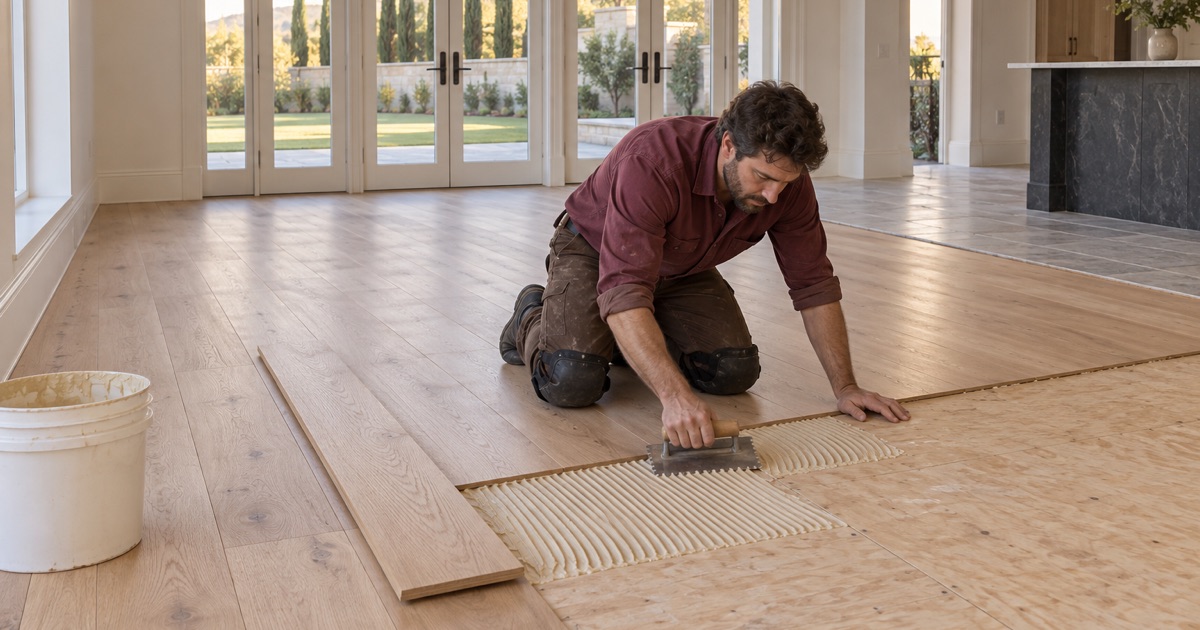
Nail-down installation uses flooring cleats or staples over a wood subfloor, and some wide products call for added adhesive as well. Glue-down installation works well for engineered wide plank over slabs.
Floating installations can be used with certain engineered products and underlayments. The method follows the manufacturer’s requirements for board width, construction and substrate.
Refinishing And Caring For Wide Plank Floors
Screen And Recoat Or Full Sanding
Wide plank floors with worn finish but intact color can often be screened and recoated. Floors with deep scratches or stains may need full sanding if the wear layer allows it.
Wide boards with slight cupping or beveled edges need a careful sanding approach so edges are not thinned. Every finish we apply meets the South Coast air district limit of 275 grams per liter for wood coatings.
Humidity Habits That Protect Wide Boards
Keeping indoor humidity reasonably steady helps wide plank floors stay tight and flat. Large swings between very dry and very humid conditions increase gapping, cupping and finish stress.
We provide care guidance with written moisture readings from your floor. That gives you a baseline if questions about gaps or movement come up later.
- 20+ Years on Wood Floors
- Room-by-Room Schedules
- Stairs Priced by the Step